
Need a reliable self-leveling solution for floors? This guide identifies five top products that help create smooth, flat subfloors for carpet, tile, vinyl, and more. Each option is suited to different project sizes, subfloor types, and skill levels. The selections below highlight best-for scenarios and practical limitations to help you decide quickly.
| Product | Best For | Key Benefit |
|---|---|---|
| DAP Flexible Floor Patch and Leveler | Small to mid-size DIY projects | Crack-resistant and sandable feather edge |
| ARDEX TL 2000 Fiber Reinforced Underlayment | Durable, commercial-grade prep | Fiber reinforcement for increased strength |
| AURIXUS Self-Leveling Cement & Epoxy Floor Tool Kit | Comprehensive DIY to semi-professional use | All-in-one kit with multiple tools |
| XWADJCD 9 Inch Spiked Roller | Air bubble removal on small to medium areas | Designed for smoothing and air release |
| Leumoi 9 Inch Spiked Roller Set | Complete starter set for epoxy and cement | Includes three rollers and accessories |
DAP Flexible Floor Patch and Leveler

Best for small repairs and pre-install leveling before carpet or vinyl. This latex-based filler fills cracks and can be sanded to a feathered edge, helping create a smooth base for floor coverings. It sets in about six hours, enabling relatively quick project progress. Ideal for DIYers tackling patching and minor level adjustments in residential spaces. Caution: Not a heavy-duty underlayment for high-traffic commercial floors.
ARDEX TL 2000 Self-Leveling Underlayment

Best for durability-focused projects needing extra strength. This fiber-reinforced, cement-based underlayment smooths and levels interior concrete, wood, and existing subfloors. Suitable for radiant heat systems and a wide range of substrates, it delivers strong performance for residential and institutional installations. Limitation: Requires proper mixing and curing conditions to maximize performance.
Self Leveling Cement Tool Kit

Best for DIYers requiring a complete kit. This tool bundle includes a self-leveling rake, spiked rollers, poles, and a pair of epoxy spike shoes, designed to spread and smooth cement or epoxy evenly. It provides ergonomic advantages and adjustable reach for larger rooms. Caution: Tool quality can vary with price—ensure components are stainless steel and compatible with your poles for best results.
XWADJCD Spiked Roller For Floor Leveling

Best for removing air bubbles in self-leveling coatings on epoxy or concrete floors. This 9-inch latex roller features 0.5-inch teeth for efficient air release and smoothing in smaller areas. Better for spot work or edge finishing; not a full-room underlayment on its own. Limitation: Primarily a finishing tool, not a standalone leveling product.
AURIXUS Self-Leveling Cement Tool Kit
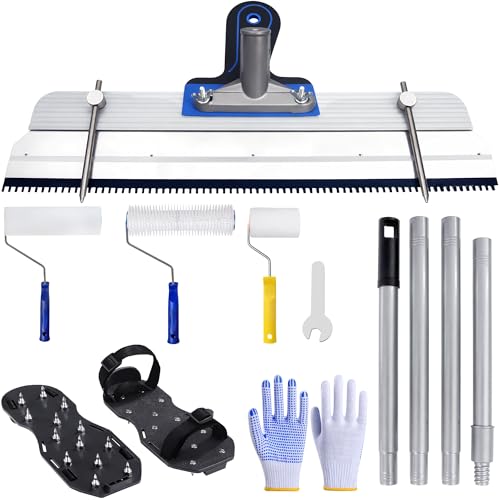
Best for a comprehensive package with multiple tools for large or repeated projects. The kit includes a self-leveling rake, 9″ and 4″ spike rollers, a paint roller, spiked shoes, extension pole, and gloves. It supports efficient spreading, bubble removal, and smooth finishing on cement or epoxy floors. Caution: Check the included extension pole compatibility with your existing hardware before purchase.
Leumoi 9 Inch Spiked Roller Set

Best for starter sets that cover essential spiked-roller needs. Includes three 9-inch spiked rollers, a roller stand, and spiked shoes. Teeth height is 0.9 inches, designed for epoxy or cement leveling and bubble-free finishes. Choose this if you want multiple rollers and a simple setup. Limitation: Basic set may require additional tools for larger commercial jobs.
Buying Guide
- Subfloor type: Concrete, wooden subfloors, or radiant heat systems may influence the best underlayment choice. Fiber-reinforced formulas offer extra durability for high-traffic areas.
- Project size: Smaller DIY patches can use patch-and-level products, while larger rooms benefit from full underlayment kits with rollers and extension poles.
- Cure time and work window: Some products set quickly, others require longer curing. Plan around room use and ventilation.
- Tools vs. products: If you already have rollers and poles, a self-leveling compound might be enough; otherwise, consider a kit with all-in-one components for convenience.
- Finish quality: For seamless, smooth finishes, prioritize products with proper bubble-release tools (spiked rollers) and compatible feather-edge capabilities.
Frequently Asked Questions
- What is self-leveling floor underlayment used for?
It creates a flat, smooth surface on uneven subfloors so flooring materials can be installed evenly.
- Can these products be used on wooden subfloors?
Yes, many cement-based underlayments are formulated for interior concrete, plywood, and OSB surfaces, but check the product spec for compatibility.
- How long do self-leveling compounds take to cure?
Cure times vary; some are usable in hours, while others require longer for full strength. Follow manufacturer guidelines.
- Do I need specialized tools to apply self-leveling compound?
Many kits include essential tools like rakes, spiked rollers, and extendable poles. Additional accessories may be helpful for larger projects.
- Are fiber-reinforced underlayments better than standard cement-based products?
Fiber reinforcement improves tensile strength and durability, beneficial for high-traffic or expansive installations.
- Can I walk on the floor after leveling?
Walking is typically allowed after initial set, but full cure may take longer. Verify cure times per product.