
If you’re searching for an effective way to redirect stormwater away from your home and landscape, pop-up drainage emitters are a reliable choice. They release collected water at safe downstream points, protect foundations, and work with common 3″ and 4″ sewer and drain fittings. This guide highlights five top options, explaining who each is best for, along with practical considerations to aid an informed purchase.
| Product | Best For | Key Benefit |
|---|---|---|
| NDS 420C Pop-Up Drainage Emitter | Homes with 3″ or 4″ drainage lines | Handles up to 40 GPM; compatible with many fittings |
| NDS 422G Pop-Up Drainage Emitter with Elbow | Downstream discharge to protect structures | Elbow connection for 4″ pipes; keeps water away from landscapes |
| Avanhitch 3″ & 4″ Pop-Up Drainage Emitter | Yards needing flush top and easy flow | Dual-rod design; flush/near-flush top |
| Calvana 3″ & 4″ Pop-Up Drainage Emitter | Rigid, fiberglass-reinforced yard outlets | 20% fiberglass reinforcement; up to 40 GPM |
NDS 420C Pop-Up Drainage Emitter
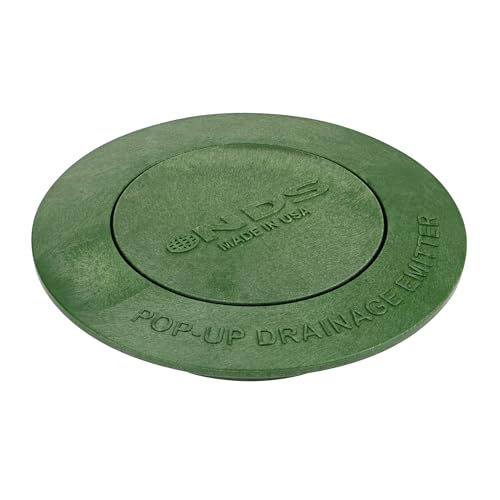
The NDS 420C connects to 3 in. and 4 in. sewer and drain fittings and works with drainage systems that include catch basins or channel drains. It releases collected water at water-safe downstream areas, helping reduce erosion-prone landscapes and foundation exposure. Best for homeowners with mixed piping in their yard drainage network and need a robust water release point. Caution: ensure compatible adapters when mixing different pipe types to maintain a leak-free system.
Who it’s best for:
- Property owners seeking a reliable, high-flow emitter (up to 40 GPM).
- Projects with pedestrian access where the system must support lawn maintenance equipment after installation.
NDS 422G Pop-Up Drainage Emitter with Elbow

This emitter captures upstream water and carries it away from structures, placing the pop-up emitter downstream. It connects to 4 in. sewer and drain pipe and can be used with 4 in. triple-wall pipe, with adapters for other pipe types. It’s best for properties needing a straightforward, downstream discharge point to shield foundations and low-lying areas.
Who it’s best for:
- Yards where a dedicated elbow connection helps direct flow away from the home.
- Systems that benefit from a flush-to-turf installation to minimize mower interference.
Avanhitch 4″ Pop Up Drainage Emitter with Elbow

This model directly fits 4″ PVC D2729, Schedule 40, SDR-35, and 3″–4″ corrugated pipe via appropriate adapters. Its dual-rod pop-up design provides smooth operation with reduced tilting and corrosion-free performance. Best for installations where the system must handle multiple pipe types and where a low-profile top is desired.
Who it’s best for:
- Yards with mixed piping and a need for dependable, spring-free opening action.
- Areas where a low-profile top minimizes mowing impact.
Calvana 3″ & 4″ Pop-Up Drainage Emitter

Calvana integrates 20% fiberglass reinforcement to improve rigidity in in-ground yard drainage applications. It connects directly to standard 3″ and 4″ sewer and drain pipe and is designed to support up to 40 GPM runoff. Best for long-term installations requiring added material strength and a flush lawn profile to reduce mower contact.
Who it’s best for:
- Plans that prioritize structural stability against soil movement and heavy loads.
- Projects needing direct compatibility with common 3″ and 4″ sewer and drain fittings.
Buying Guide: How to Choose The Right Pop-Up Drainage Emitter
What pipe size do you have?
Most pop-up emitters fit 3″ or 4″ sewer and drain fittings. Confirm your system’s pipe size and pick an emitter that matches to avoid adapters that can introduce leaks or flow restrictions.
How much flow do you need?
If your property experiences heavy rainfall or has large drainage areas, select emitters rated up to 40 GPM or more. Higher flow capacity reduces the risk of backflow and standing water near the home.
Should you choose a dual-rod or spring-loaded design?
Dual-rod designs typically offer smoother operation and less sticking than traditional spring-loaded emitters. If you want low maintenance and reliable opening/closing, a dual-rod model is a practical choice.
What about installation compatibility?
Check whether the emitter requires adapters for your pipe type (PVC, S&D, SDR, corrugated). Some models specify compatibility with 3″ and 4″ pipes but may need adapters for non-standard fittings.
Top considerations for lawn and landscape impact
- Top profile: A low-profile or flush finish minimizes mower interference and blade collisions.
- Flange design: A wide outer flange helps prevent grass from clogging the emitter and reduces tripping hazards.
- Material strength: Fiberglass-reinforced housings can provide durability in buried installations.
Frequently Asked Questions
- What is a pop-up drainage emitter?
It is a device installed at the end of a drainage line to release collected stormwater at a designated, safe location while allowing the outlet to pop up under water pressure and retract when flow subsides.
- Can these emitters handle lawn mower traffic?
- Do emitters require maintenance?
- Are adapters always necessary?
- Which emitter is best for long-term in-ground use?
Many emitters are designed to support pedestrian traffic or lawn equipment when properly installed, but always verify the load rating for your specific model.
Yes, periodic checks for clogs or soil buildup are recommended to prevent blockages and ensure consistent flow.
Adapters are sometimes required to match different pipe types (PVC, SDR, corrugated, etc.). Review the product’s installation notes to determine need.
Models with fiberglass reinforcement or corrosion-resistant components tend to offer better rigidity and durability for buried installations.