
Answering the common buyer question: which hot water storage tank best supports boiler-based heating or combined solar and boiler setups? This guide highlights five solid options, explains who each is best for, and outlines practical buying considerations. Ideal for homeowners upgrading a boiler system, installers designing solar-boosted heating, and individuals seeking reliable hot water storage with straightforward maintenance.
| Product | Capacity | Best For |
|---|---|---|
| 150 Liter 40 Gallon Stainless Steel Solar Hot Water Heater Tank | 150 L / 40 gal | Solar-assisted boilers; durable corrosion resistance |
| Watts ETX-30 Expansion Tank | 4.7 gal | Closed-loop boiler/hydronic systems; pressure management |
| VEVOR Electric Water Heater, 18 Gallon | 18 gal | Households needing quick hot water on demand |
| Portable 160L Stainless Steel Water Storage Tank | 160 L / 42.3 gal | Direct-connection storage; portable, flexible placement |
| 13 Gallon Electric Water Heater | 13 gal | Small spaces; secondary heat support |
150 Liter Stainless Steel Solar Tank With Copper Coil

Best for solar-boosted boiler systems. This 150 L tank uses a food-grade SUS 304 inner tank with a 66 ft copper coil, designed to integrate with solar collectors or boiler loops. The insulation provides an R-12.5 value for reduced heat loss, and the high-density polyurethane foam minimizes standby losses. Best for homes seeking a robust, durable storage option with a long coil for efficient heat exchange. Caution: ensure compatibility with your solar or boiler loop pressures and mounting space before purchase.
Watts ETX-30 4.5 Gal Expansion Tank

Best for boiler or radiant heating systems requiring expansion management and pressure regulation. This pre-charged tank handles closed-loop systems up to 60 psi and helps prevent hydrostatic shock. It is a compact, cost-effective option to maintain system stability. Choose this if your boiler setup needs reliable expansion control and a straightforward installation. Limitation: not a primary hot water storage vessel for domestic use.
VEVOR 18 Gallon Electric Water Heater

This 18-gallon electric unit supports households needing consistent hot water with a 1600W element for faster recovery. It features an enamel coating for safer operation and a rotary temperature control from 30℃ to 75℃. Best for small-to-medium homes or as a supplemental storage tank tied to a boiler system, offering straightforward integration and user-friendly controls. Caution: check electrical capacity and spacing for mounting in tight utility areas.
Portable 160L Stainless Steel Water Storage Tank
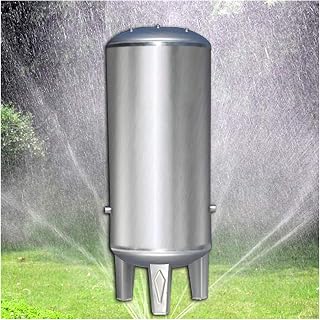
Best for flexible placement and direct storage needs. This 160 L flatted-tank design emphasizes food-grade stainless steel and a fully automatic operation principle with a pump-driven, air-pressure-based water supply. It includes safety features like pressure-relief design and a robust temperature range. Choose this if you need portable or modular storage in a boiler-boosted system. Limitation: portability may reduce compactness in tight boiler rooms.
13 Gallon Electric Water Heater

Best for small spaces or as a secondary storage option for boiler hybrids. This compact unit provides a ready supply of hot water without occupying a large footprint. It is suitable for apartments, utility closets, or as a boost tank in a larger boiler system. Caution: smaller capacity may require more frequent reheat in busy households; ensure it fits your space and heat-load needs.
Buying Guide: Key Considerations For Hot Water Storage Tanks In Boiler Systems
- Capacity vs. demand: Match tank size to daily hot water usage and boiler output to avoid shortfalls or excessive standby losses.
- Material and durability: Stainless steel inner tanks resist corrosion; enamel coatings reduce burn hazards and leaks. Consider insulation value (R-value) to minimize heat loss.
- System compatibility: For boiler-hydronic setups, ensure pressure and loop compatibility, particularly with expansion tanks and solar integration.
- Heat source integration: Determine whether the tank is primarily for domestic hot water, solar-assisted heating, or as a backup for boiler heat.
- Space and installation: Check available mounting area, clearance for connections, and electrical or solar interface requirements.
- Maintenance: Look for tanks with accessible fittings, easy coil replacements, and clear manufacturer guidelines.
Frequently Asked Questions
- What is the difference between a storage tank and an expansion tank in boiler systems?
– A storage tank stores hot water for domestic use, while an expansion tank absorbs pressure changes in closed-loop heating systems to protect components. - Can a hot water storage tank be solar-assisted?
– Yes, many tanks are designed to integrate with solar collectors to improve efficiency and reduce fuel use. - Is a larger tank always better for a boiler system?
– Not necessarily; it depends on demand, heating rate, and system size. Oversizing increases standby losses. - What maintenance steps are essential for these tanks?
– Regular inspections of fittings, insulation integrity, and coil or heat exchanger condition; flush to remove sediment when applicable. - Are these tanks energy-rated?
– Many tanks use high-efficiency insulation and coatings, but always verify R-values and energy performance from product specs.