
Find reliable end wall flashing for corrugated roofing by comparing flexible, EPDM, silicone, and metal options. This guide highlights five top picks suited for different roof pitches and pipe sizes. Ideal buyers include do-it-yourself homeowners, roof contractors, and builders seeking durable, weather-resistant flashings that fit corrugated panels and varied pipe diameters. The table below summarizes each product’s best-use scenario to help you choose quickly.
| Product | Best For | Pipe Size | Material |
|---|---|---|---|
| VIVIDA #3 Metal Roof Pipe Flashing | Corrugated metal roofs with 1/4″ to 5″ OD pipes | 1/4″–5″ | Rubber |
| Flashers #3 Black EPDM Round Flashing | Residential corrugated roofs needing quick installation | 1/4″–5″ | EPDM |
| ACNOYEL #3 Metal Roof Vents Flashing | Houses with varied corrugated and flat sections | 1/4″–5-3/4″ | EPDM/Aluminum |
| Flashers #1 Black EPDM Round Flashing | Smaller pipes and quick DIY fixes | 1/4″–2″ | EPDM |
| Flashers #8 Silicone Square Flashing | High-temperature environments and larger pipes | 7″–13″ | Silicone |
VIVIDA #3 Metal Roof Pipe Flashing, 1 Pack
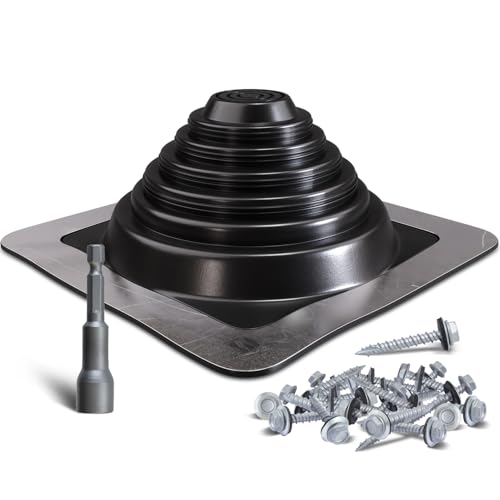
Best for corrugated metal roofs with a bendable square base that can align to rib lines. The kit supports 1/4″ to 5″ OD pipes and includes screws and a hex socket. The base is designed to conform to typical corrugated panels, offering a stable seal without over-tightening. A potential limitation is that deeper corrugations (more than 1.5″ depth) may require the next size or a square-base flashing to ensure a proper fit.
Who it’s best for: DIY homeowners and small contractors needing a flexible, size-range pipe boot for corrugated roofs. Why selected: Combines adaptability with straightforward installation, ideal for 10/12 to 12/12 pitches.
Roof Corner Flashing for Inside & Outside Corners

Best for roof-to-wall penetrations at corners, including chimneys, dormers, and garages. Made from hand-soldered G90 galvanized steel for enhanced waterproofing. Suitable for flat or pitched roofs and available in multi-pack formats for contractor use. Caution: heavier metal may be less forgiving on tight radiuses; ensure exact corner dimensions before purchase.
Who it’s best for: Builders and pros handling corner flashings on varied roof styles. Why selected: Superior waterproofing from soldered seams and robust steel construction.
Flashers #3 Black EPDM Round Flashing

Best for quick installs on corrugated roofs where 1/4″ to 5″ pipes are used. This flashing is 100% Made in the USA and uses EPDM, offering a broad temperature service range. A limitation is that measurements should be double-checked to match the external diameter of the pipe, preventing an ill-fitting boot.
Who it’s best for: Homeowners and contractors seeking a locally produced, reliable EPDM option. Why selected: Simple, ready-to-use round flashing that matches common pipe sizes on residential projects.
#3 Metal Roof Vents Flashing for Pipes 1/4″–5″

Best for corrugated roofs needing a robust EPDM aluminum combo. The kit covers 1/4″ to 5″ OD pipes and includes screws, a hex bit socket, and scissors. The dual-material construction can handle more extreme temperatures. Limitation: some installations may require trimming sleeves for exact pipe diameter matches.
Who it’s best for: DIYers and small crews working on varied corrugated surfaces. Why selected: Flexible and durable with practical accessories for installation and sizing.
Flashers #8 Silicone Square High-Temp Flashing

Best for high-temperature environments and larger-diameter pipes (7″–13″). Silicone construction withstands extreme heat and offers strong flexibility. A limitation is that silicone flashings are typically more specialized and may require careful sizing and adaptation for non-standard pipe diameters.
Who it’s best for: Projects near heat sources or where high-temperature resistance is critical. Why selected: Superior heat tolerance makes it suitable for hot climates or metal roofing with high sun exposure.
Buying Guide
What material should I choose for corrugated roofing flashings?
EPDM offers good weather resistance and flexibility for typical residential corrugated roofs. Silicone provides higher temperature tolerance and durability in harsh environments. Metal flashings are robust but less forgiving on complex curves. Choose based on climate, pipe size, and installation ease.
How do I determine the correct pipe size?
Measure the outer diameter of the pipe (OD) that will pass through the flashing. Choose a boot that accommodates the full OD with room for sealant or screws. If in doubt, select a slightly larger size that allows trimming to fit.
What installation considerations prevent leaks?
Ensure a snug fit against the corrugation, use compatible sealants or gaskets, and avoid overtightening screws which can warp the base. For deep corrugations, prefer square-base designs or larger flashings to align with the panel ribs.
Are multi-pack options worth it for contractors?
Yes. Multi-pack flashings reduce trips to the store and provide compatibility across multiple pipes and roof areas. Larger projects benefit from consistency and faster installation times.
What are common limitations to watch for?
Some flashings are optimized for specific pitches or corrugation depths. Ensure the chosen product matches your roof pitch, corrugation depth, and environmental conditions to prevent poor seals or premature wear.
How should I compare products quickly?
Focus on pipe size range, material, temperature tolerance, included hardware, and whether the product is designed for inside or outside corners, corners, or flat sections. Practical tests include dry-fitting before sealing to ensure a leak-proof fit.
FAQ
- Which flashing is best for extreme heat? – Silicone flashings (like the 8-inch silicone square) generally offer the highest heat tolerance.
- Can I use EPDM flashings on metal roofs? – Yes, many EPDM options are designed for corrugated metal and perform well within standard pipe sizes.
- Do I need a square-base flashing for corrugated panels? – Square-base designs help align with rib lines on deeper corrugations and can improve sealing.
- How do I avoid leaks at corners? – Use corner flashings with soldered or welded seams and ensure proper sealing at the joint to the roof wall.
- Should I buy a multi-pack? – If you have multiple penetrations, a multi-pack saves time and ensures consistent sizing.
- Is measuring the pipe diameter enough to choose flashing? – Measuring OD is essential; consider potential overhang or trimming for precise fit.