
If you’re searching for an automatic sump pump for basement water removal, these top five options offer reliable automatic on/off sensors, solid flow rates, and practical features to protect your space. The best fit depends on your basement size, expected water volume, and the level of automation you want. This guide highlights who each pump is best for, plus a concise buying summary to compare key points at a glance.
| Product | Best For | Key Benefit |
|---|---|---|
| Acquaer 1/3 HP | Small to medium basements | Smart sensor auto on/off, debris-filtered bottom suction |
| Cleartide 1/3 HP | Rapid draining needs | High flow rate, dual auto/manual modes |
| Aquastrong 1/2 HP | Moderate-to-large areas | Adjustable auto levels, 26 ft lift |
| FOTING 1HP | Heavy water volumes | High capacity, 4600 GPH, durable |
| Green Expert 1/3HP | Low-water scenarios | Ultra-low final drain, dual mode |
Acquaer 1/3 HP Automatic Submersible Water Pump

Best for small to medium basement drains where automatic on/off is valued. This pump runs with a built-in smart sensor that starts at 1-1/2 inches of water and stops below 1/4 inch. It moves up to 2160 GPH and features bottom suction to filter debris and drain to 1/4 inch. A temperature control core helps prevent dry-run damage, and the strainer base is easy to clean. Choose this for compact setups requiring straightforward auto operation and debris filtration.
Who it’s for: homeowners with modest water inflows and a desire for simple, automatic operation. Caution: the 10-foot cord may limit placement distance from outlets in larger spaces.
Cleartide 1/3 HP Submersible Utility Pump

Best for higher flow needs with flexible operation. It supports auto and manual modes, starting at 1-1/5 inches and stopping at 1/5 inch, with a 2790 GPH capacity and 30-foot lift. The copper-wound motor runs cooler, and the thermoplastic housing resists corrosion. This model suits flooded basements or large pools where quick drainage matters. Caution: copper winding may be sensitive to improper submersion in certain environments.
Who it’s for: households facing faster water removal requirements; those who want a strong auto option plus reliable manual override. Better for: larger leaks or short-notice drainage tasks. Avoid if: you need ultra-quiet operation in a very small room.
Aquastrong 1/2 HP Automatic Sump Pump

Best for moderate-to-large basement spaces requiring solid automatic control. It features a built-in sensor with adjustable water level triggers (five levels) and a shutoff at 0.4 inches. The 1/2 HP motor drains up to 3159 GPH and lifts water up to 26 feet. A 10-foot UL power cord adds convenience for placement. Choose this for flexible auto thresholds and dependable draining performance. Caution: ensure correct adapter sizing for your discharge needs to avoid fit issues.
Who it’s for: users who want a versatile auto-sensing pump with clear level settings and solid lift. Better for: basements with variable water depths. Avoid if: you require higher vertical lift than 26 feet.
FOTING 1HP Sump Pump 4600GPH
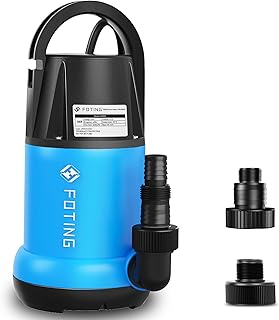
Best for high-volume drainage needs where speed matters. The 1 HP motor delivers up to 4600 GPH with a 31-foot lift and a 1/5-inch discharge capability. It’s a portable, thermoplastic pump with a 10-foot power cord. This model suits large basements, pools, or heavy flood scenarios where rapid removal is essential. Caution: larger size may require more clearance for installation and retrieval.
Who it’s for: buyers handling frequent large-volume water removal. Better for: fast response tasks and longer pumping sessions. Choose this if: you need maximum flow and aren’t constrained by space.
Green Expert 1/3HP Submersible Sump Pump

Best for versatile use with a focus on lowest-water draining. It combines automatic and manual modes, moving up to 2000 GPH with a 22.5 GPM at 10 feet. The oil-free PSC motor includes thermal protection for safer operation. It drains down to the lowest water level possible with a backflow-preventing valve. Use this when you want a compact, adaptable option that can run quietly in smaller spaces. Caution: performance is best on rigid, flat surfaces; soft covers may impede the ultra-low base.
Who it’s for: small to medium spaces requiring automatic operation and low-water efficiency. Better for: quick air-gap free drains on flat floors. Avoid if: your setup has soft or irregular flooring where the base may wobble.
Buying Guide
What to consider when choosing an automatic sump pump for a basement:
- Water volume and drain rate: Match GPH and lift to the expected water volume and height in your basement to avoid underperforming or overloading the pump.
- Automatic vs. manual modes: Auto sensors simplify maintenance, while manual control offers on-demand flexibility for unusual tasks.
- Discharge and hose compatibility: Check inlet/outlet sizes and available adapters to fit existing drain systems or sump pits.
- Power cord length and outlet access: Longer cords provide placement flexibility but ensure outlets are GFCI-protected and accessible.
- Durability and materials: Thermoplastic housings resist corrosion; copper-wound motors can run cooler but may require careful use in certain environments.
- Debris handling: A bottom suction design or a built-in strainer helps prevent clogs; consider your water quality and debris load.
- Installation space: Ensure enough clearance for maintenance and cleaning; heavier models may need additional supports.
Frequently Asked Questions
- What is an automatic sump pump?
An automatic sump pump starts and stops based on water level, typically using a built-in sensor to manage drainage without manual operation.
- How much water can a sump pump move per hour?
Rated GPH (gallons per hour) ranges from about 2000 to 4600 GPH in the models listed, with lift height affecting performance.
- Can I install a sump pump in a window well or pool area?
Yes, many pumps support drainage from pools, hot tubs, or basements, but confirm discharge fittings and power requirements first.
- Do I need a high-precision sensor for basements?
Auto sensors help prevent flooding by reacting quickly to rising water; consider a model with adjustable thresholds if your space varies.
- Is a 10-foot power cord enough for most basements?
Often yes, but larger spaces might require longer cords or additional outlets; ensure safe, code-compliant wiring.
- What maintenance do sump pumps require?
Regularly inspect and clean strainers, check for debris, and test auto mode to confirm proper operation.